This is part of a series of writings from Noble staff that celebrate heritage and history. This piece was written to celebrate Latinx Heritage Month in 2026.
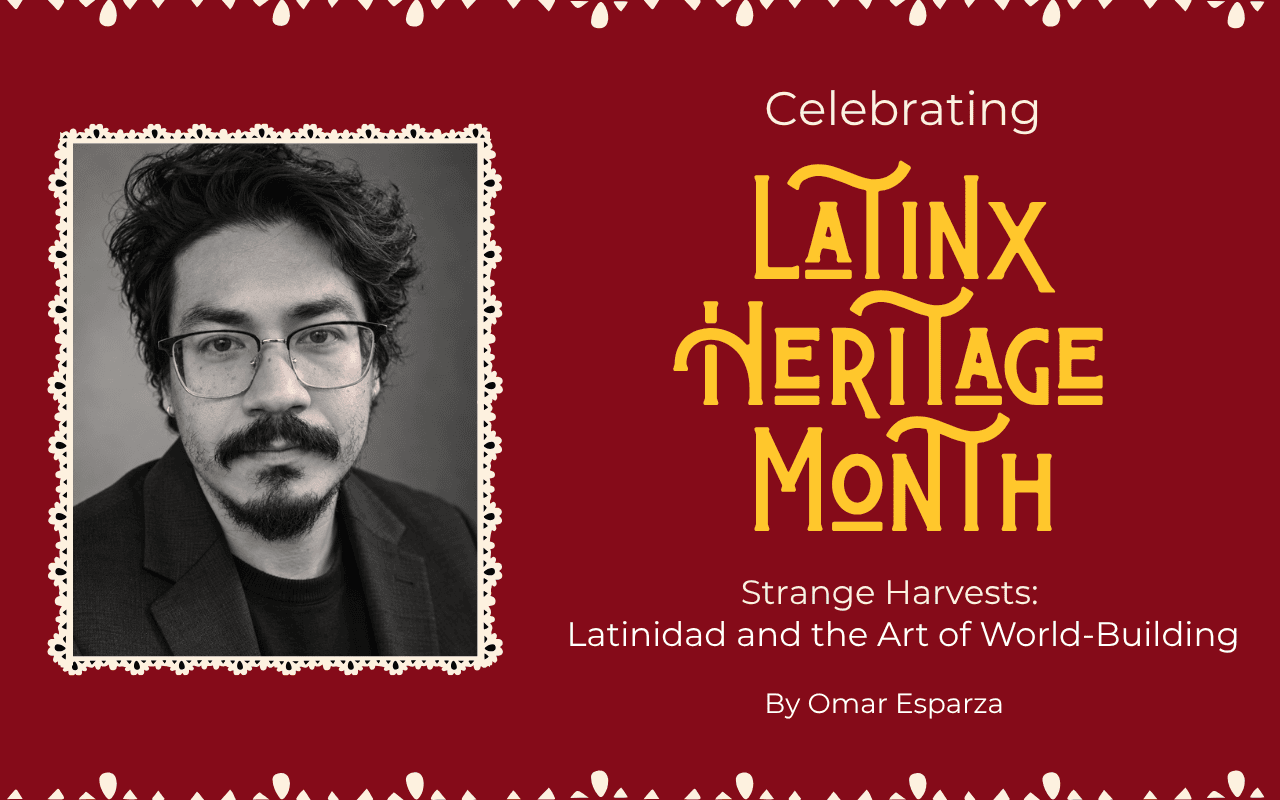
By Omar Esparza | he/him/el
English Language Arts Teacher and 12th Grade Lead, Pritzker College Prep
“All that is strange is marvelous.”
—Alejo Carpentier, “The Baroque and the Marvelous Real”
What is Latinidad? I don’t know. I’ve never known. How could I? The older I get, the more I realize that the strange harvests growing in me are there by design. To be Latinx, to be me, to be our students, to be us—is to exist at the epicenter of countless intersecting categories. To be Latinx is to be a paradox.
But Latinidad is a peculiar paradox, unfamiliar even in a complex of ambiguities. Why the honor? Because Latinidad exposes the inadequacies of the binaries upholding the apparatus of the modern world: we are not a race; we are strangers in lands built from our histories, citizens made strangers and strangers made citizens. We are by virtue of what we are not: we’re the vivid reminder that humans are defined precisely by their ineffable remainders—supremely inadmissible yet forever unassimilable. We’re the living mockery of every attempt to confine the Human to a set of data points.
“What is a Human?” you ask. I can’t say. Now, neither can you. Latinidad is this gift of radical uncontainability.
And so, we’re a threat.
Only what is structured can be governed. Power therefore names, classifies, crafts borders. Latinidad is the living frustration of that attempt. We’re not outside the categories. We are the mushrooms that bloom after their failure. We’re the eternal confession of the soul’s freedom resounding from the deep.
Our students know this instinctively. Instinctively, that is, because Latinidad’s truths can’t be taught. Yet it’s something we all can learn from. Our students walk through the doors of Noble campuses across the city, instantiating vast and complex histories. They glide from language to language without hesitation. They carry worlds within worlds. They argue with us (and win); they laugh loudly (and make us laugh, too); they cross hostile and friendly worlds alike with ease. They are magical, and they are real.
It’s too simple to say Latinidad means “resilient.” That’s what my students have taught me. Latinidad does not mean enduring the invasion of our communities. It does not mean waiting for justice to arrive. We are not merely “survivors.” We are the makers of worlds, of worlds within worlds, and worlds within worlds within… That is the jewel of our inheritance, the source of our indefinability: we are not simply más. In itself, más cannot be described as the core of our Latinidad. Más is a neutral term. Más can mean “more pain,” “more suffering,” or “more of the same.” Therefore, the más of our Latinidad must always be más que más and must consciously own the ungovernable surpluses of Spirit. This can only be achieved when we collectively recognize Latinidad for what it truly is (and isn’t). So, let us embody what our students already know: we do not endure the worlds we inherit. We are world-builders, song-makers, and champions of all that is cheerful and good. Our inexhaustible plurality is what unites us.
But we’re not a simple unity. How could we be, given what has been laid out in this simple note? For this reason, this Latinx Heritage Month, I call on you to reimagine what it means to be one or many. We must recreate what it means to be a people. That is our task, our endless destiny. We must be more than a collection of sameness. Apart, we are más. Pero:
¡Unidos, somos más que más!
Cosechas extrañas: La latinidad y el arte del construir mundos
Por Omar Esparza | he/him/el
Profesora de Lengua y Literatura Inglesa y coordinadora del 12.º grado, Pritzker College Prep
Todo lo extraño es maravilloso.
—Alejo Carpentier, El barroco y lo real maravilloso
¿Qué es la latinidad? No lo sé. Nunca lo he sabido. ¿Cómo podría? Cuanto más envejezco, más me doy cuenta de que las cosechas extrañas que crecen en mí están ahí a propósito. Ser Latinx, ser yo, ser nuestros estudiantes, ser nosotros, es existir en el epicentro de innumerables categorías que se entrecruzan. Ser latinx es ser una paradoja.
Pero la Latinidad es una paradoja peculiar, desconocida incluso en un entramado de ambigüedades. ¿Por qué este honor? Porque la latinidad pone al descubierto las insuficiencias de los binarios que sostienen el aparato del mundo moderno: no somos una raza; somos extranjeros en tierras construidas a partir de nuestras historias, ciudadanos convertidos en extranjeros y extranjeros convertidos en ciudadanos. Somos en virtud de lo que no somos: somos el vívido recordatorio de que los seres humanos se definen precisamente por sus restos inefables —supremamente
inadmisibles y, sin embargo, para siempre inasimilables. Somos la burla viviente de todo intento de confinar a lo humano a un conjunto de puntos de datos.
¿Qué es un humano? preguntas. No puedo decirlo. Ahora, tú tampoco puedes. La latinidad es este don de la incontinencia radical.
Y por eso somos una amenaza.
Solo lo que está estructurado puede ser gobernado. El poder, por lo tanto, nombra, clasifica, traza fronteras.
La latinidad es la frustración viviente de ese intento. No estamos fuera de las categorías. Somos los hongos que florecen tras su fracaso. Somos la eterna confesión de la libertad del alma que resuena desde lo más profundo.
Nuestros estudiantes lo saben instintivamente. Instintivamente, es decir, porque las verdades de la latinidad no se pueden enseñar. Sin embargo, es algo de lo que todos podemos aprender. Nuestros estudiantes cruzan las puertas de las escuelas de Noble por toda la ciudad, encarnando historias vastas y complejas. Pasan de un idioma a otro sin vacilar. Llevan mundos dentro de mundos. Discuten con nosotros (y ganan); se ríen a carcajadas (y nos hacen reír también); atraviesan mundos hostiles y amigables por igual con facilidad. Son mágicos y son reales.
Es demasiado simple decir que la Latinidad significa resiliencia. Eso es lo que mis estudiantes me han enseñado.
La latinidad no significa soportar la invasión de nuestras comunidades. No significa esperar a que llegue la justicia. No somos meros supervivientes. Somos los creadores de mundos, de mundos dentro de mundos, y de mundos dentro de mundos dentro de… Esa es la joya de nuestra herencia, la fuente de nuestra indefinibilidad: no somos simplemente más. En sí mismo, más no puede describirse como el núcleo de nuestra latinidad. Más es un término neutral. Más puede significar más dolor, más sufrimiento o más de lo mismo. Por lo tanto, el más de nuestra latinidad debe ser siempre más que más y debe apropiarse conscientemente de los excedentes ingobernables del Espíritu. Esto solo se puede lograr cuando, colectivamente, reconocemos la latinidad por lo que verdaderamente es (y no por lo que no es). Así pues, encarnemos lo que nuestros estudiantes ya saben: no soportamos los mundos que heredamos. Somos constructores de mundos, creadores de canciones y defensores de todo lo que es alegre y bueno. Nuestra inagotable pluralidad es lo que nos une.
Pero no somos una simple unidad. ¿Cómo podríamos serlo, dado lo que se ha expuesto en esta sencilla nota?
Por esta razón, en este Mes de la Herencia Latinx, los invito a reimaginar lo que significa ser uno o muchos. Debemos recrear lo que significa ser un pueblo. Esa es nuestra tarea, nuestro destino infinito.
Debemos ser más que una colección de uniformidad. Por separado, somos más. Pero:
¡Unidos, somos más que más!
奇异的收获: 拉丁性与世界构建的艺术
By Omar Esparza | 他
英语语言艺术教师兼12年级负责人普利兹克大学预科学校
“一切奇异之事皆为奇妙。”
阿莱霍·卡彭蒂耶,《巴洛克与奇妙的现实》
什么是拉丁性?我不知道。我从未知晓。我又怎能知晓?
但“拉丁性”是一种独特的悖论,
“什么是人?”你问。我无法回答。现在,你也无法回答。“
因此,我们是一种威胁。
唯有被结构化的事物才能被治理。因此,权力进行命名、分类、
拉丁性正是对这种企图的鲜活挫败。我们并非身处分类体系之外。
我们的学生本能地明白这一点。之所以说是本能,
若说“拉丁性”仅意味着“坚韧”,未免过于简单。
“拉丁性”并不意味着忍受对我们社区的入侵。
但我们并非简单的统一体。鉴于这篇简短笔记中所阐述的内容,
正因如此,在这个拉丁裔传统月,我呼吁大家重新构想“一体”或“
我们绝不能仅仅是同质群体的集合。分离时,我们是“más”(
“团结起来,我们远不止于‘更多’!”
Read more by Noble Schools staff…


Share This Story, Choose Your Platform!
For information about enrolling at a Noble School or employment opportunities please, click below.
 Alumni Spotlight: Quincy Stone's Basketball Journey at Rowe-Clark Math & Science Academy